Getting battery sizing right is the single most important decision in a solar battery purchase. Too small and you exhaust it before midnight; too large and you pay for capacity you never use. Neither is good value — and with batteries still representing a significant upfront cost even after the federal government's Cheaper Home Batteries Program rebate, getting the number right matters.
Start with your evening load, not your daily total
The most common mistake homeowners make is sizing a battery against their total daily consumption. That figure is irrelevant. What matters is how much electricity you use after the sun goes down — typically from around 4 pm to 10 pm, and again in the early morning before solar generation picks up.
For most Australian households, that evening window accounts for roughly 8–12 kWh, depending on household size, whether you run air conditioning, and the season. A 2-person household in a mild climate might use 5–7 kWh in the evening; a family of four running ducted heating or cooling in winter or summer can easily reach 12–15 kWh.
To estimate your own figure, pull up your electricity bill's daily usage total and assume 50–60% of that falls outside solar hours. A household using 20 kWh/day is therefore aiming to cover roughly 10–12 kWh with a battery.
Important note on seasonal variation. Winter evenings run longer and cooler, pushing up heating loads at exactly the time your solar is producing less. Size your battery for a realistic winter evening, not your sunniest summer day.
Understand usable capacity — not the number on the box
Battery manufacturers advertise nominal (total) capacity. What you can actually draw from the battery is the usable capacity, which depends on the battery's maximum depth of discharge (DoD).
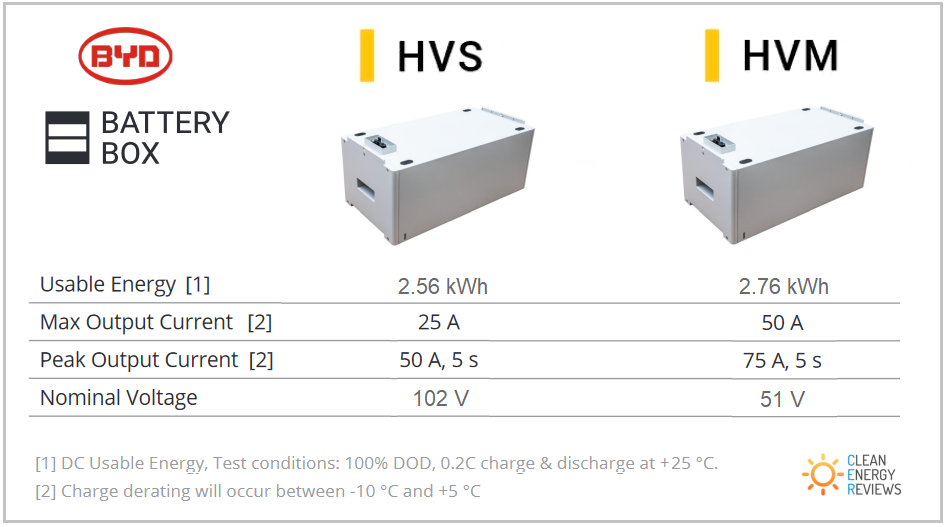
Most modern lithium batteries — particularly lithium iron phosphate (LiFePO4) chemistry, which has become increasingly common in Australian residential installations — are rated at 90–100% DoD. In practical terms, a 13.5 kWh Tesla Powerwall 3 provides approximately 13.5 kWh of usable energy; a BYD HVM 16.6 kWh unit provides roughly 16.6 kWh usable. NMC chemistry (used in some popular products including the older Powerwall 2) sometimes caps usable capacity at 80–90% of nominal, so it is worth checking the spec sheet for any product you are comparing.
Always confirm usable capacity with your installer before comparing prices. A "10 kWh" battery from one brand may deliver only 8.5 kWh in practice.
There is also a practical consideration for the federal rebate: the Cheaper Home Batteries Program (which launched 1 July 2025) applies STCs only to the first 50 kWh of a battery's usable capacity — so the nominated figure matters for the rebate calculation too.
Factor in your solar surplus
A battery can only store what your solar panels generate in excess of your daytime consumption. If you work from home, run a pool pump, or have a dishwasher running during the day, your daytime self-consumption reduces the surplus available to store.
As a rough guide for a standard 6.6 kW system:
- Sydney/Brisbane: 8–14 kWh of daily surplus is typical in summer; 4–8 kWh in winter
- Melbourne/Adelaide: 5–10 kWh surplus in summer; as low as 2–5 kWh in winter
If your surplus is consistently below 6 kWh, a battery larger than 10 kWh is unlikely to charge fully on most days — meaning you would be paying for capacity that sits empty.
Export limits and inverter compatibility. Many network distributors cap household solar exports at 1.5–5 kW — even if your system generates far more. If your system is export-limited, a battery's charging window is effectively extended (surplus energy that would have been curtailed goes to the battery instead), which can make a larger battery more justifiable. Check your network's export limit and whether it applies to you. Separately, confirm with your installer that your existing inverter is compatible with the battery you are considering — not all string inverters support all battery types, and a battery that requires a new inverter will cost significantly more than the quoted battery price alone.
The right-sizing method: work through it step by step
Rather than guessing, work through these four steps:
-
Find your evening load. From your electricity bill or smart meter data, estimate how many kWh you use between 4 pm and 10 pm on a typical winter weekday. Call this E.
-
Find your daily solar surplus. Your installer or your inverter's monitoring app will show daily export figures. Take an average across several months, including winter. Call this S.
-
Take the lower of the two. Your optimal usable battery size is roughly
min(E, S × 0.90). The 0.90 discount accounts for round-trip efficiency losses — modern LFP batteries typically return 90–95% of the energy stored, so a 10% planning buffer is realistic. -
Confirm the nominal size needed. Divide your usable target by the battery's DoD (as a decimal). For a 90% DoD battery targeting 10 kWh usable:
10 ÷ 0.90 = 11.1 kWh nominal minimum.
Worked example — 3-bedroom household, Brisbane
| Input | Value |
|---|---|
| Daily electricity use | 22 kWh/day |
| Estimated evening load (55%) | ~12 kWh |
| Average daily solar surplus (6.6 kW system) | ~10 kWh |
| Surplus after round-trip efficiency (×0.90) | ~9 kWh |
| Recommended usable capacity | ~9–10 kWh |
| Recommended nominal (÷ 0.90 DoD) | ~10–11 kWh nominal |
A 10–13.5 kWh battery (e.g. BYD HVM 10.2 kWh or Tesla Powerwall 3) would be appropriate for this household. Going to 16–20 kWh would leave the battery frequently under-charged, reducing its effective return on investment.
Worked example — 2-person household, Melbourne
| Input | Value |
|---|---|
| Daily electricity use | 14 kWh/day |
| Estimated evening load (55%) | ~8 kWh |
| Average daily solar surplus (6.6 kW system, winter) | ~5–6 kWh |
| Surplus after efficiency | ~4.5–5.5 kWh |
| Recommended usable capacity | ~5–6 kWh |
| Recommended nominal | ~5.5–7 kWh nominal |
A 5–7 kWh battery covers this household's realistic daily cycling. Upsizing to 13.5 kWh would mean the battery only half-charges on most winter days.
A note on charge rate
Battery capacity tells you how much energy a battery can store; charge rate (measured in kW) tells you how quickly it can absorb that energy. A 10 kWh battery that can only charge at 3 kW takes over 3 hours to fill from empty. If your solar surplus arrives in a short window — say 10 am to 2 pm in winter — and your battery can only charge at 3–5 kW, it may not fully charge even if the total day's surplus exceeds the battery's capacity. Check the continuous charge power specification, not just the storage capacity, before you buy.
Battery degradation: plan for year 10, not year 1
Modern LiFePO4 batteries degrade at roughly 1–2% per year under typical daily cycling conditions. A 10 kWh battery installed today may deliver around 8–9 kWh usable capacity after ten years. Most manufacturers warranty at least 70–80% of original capacity over 10 years or a specified number of cycles (typically 6,000–10,000 for LFP).
Two practical implications:
- Size slightly above your minimum. If your analysis says 9 kWh is the sweet spot today, consider a 10–11 kWh nominal battery to maintain adequate capacity as the battery ages.
- Installation environment matters in Australia. Batteries installed in hot, poorly ventilated locations — a west-facing garage wall in Queensland, for example — will degrade faster. Ask your installer about shading or ventilation requirements for your specific product.
Don't over-buy to "future-proof"
The most common upsell in the industry is the "future-proof" pitch — buy a 20 kWh battery now in case you add an EV later. This can make sense, but only if you have a credible plan to add load within a couple of years. Otherwise, a battery that sits at 20–30% state of charge most days is not just wasted money — partial cycling can actually reduce longevity in some battery chemistries.
If an EV is genuinely in your near-term plans, a better approach is often to choose a battery with an expandable architecture (some brands allow additional modules to be added later) rather than buying maximum capacity upfront.
Use a calculator, not just a rule of thumb
The method above gives you a reliable starting point. Your actual optimal size depends on your specific tariff structure (flat rate, time-of-use, or feed-in), your inverter's charge rate limits, your location's solar irradiance, and whether you want whole-home backup capability.
Our free battery sizing calculator runs a full hourly simulation based on your inputs and shows payback period and ROI for different battery sizes — so you can find the sweet spot for your exact situation before talking to an installer.