If you installed solar in Australia before 2015, you may remember receiving 20, 30, or even 44–60 cents per kilowatt-hour for power you exported to the grid. Today, most Australian households are receiving between 3 and 6 cents per kWh — and in some states, the effective rate during sunny midday hours can be zero.
This shift has fundamentally changed the economics of solar ownership, and it is the primary driver behind the growing case for batteries and self-consumption strategies.
Why have feed-in tariffs fallen so sharply?
The premium rates of the early 2010s were explicit government incentives designed to kick-start solar adoption. South Australia's 44 c/kWh scheme (launched 2008) and NSW's 60 c/kWh Solar Bonus Scheme (closed to new applicants 2011) were never intended to last indefinitely — they reflected the cost of building new generation capacity at the time, not the actual value of solar power to the grid.
Today, rooftop solar has reached saturation levels that early policymakers could not have anticipated. According to AEMO's Quarterly Energy Dynamics, in Q4 2025 negative or zero wholesale electricity prices occurred in 31 per cent of all dispatch intervals across the National Electricity Market — up from 23 per cent in the same quarter the previous year. During sunny midday windows, the wholesale spot price regularly falls below zero, meaning exported rooftop solar has little or no commercial value to retailers. Those retailers have passed this reality through to customers.
The result by state as at mid-2026:
- New South Wales: benchmark FiT range 4.8–7.3 c/kWh; market offers typically 3–7 c/kWh
- Victoria: regulated minimum removed from 1 July 2025; flat rate would have been 0.04 c/kWh; most retailers now offer 3–6 c/kWh; time-varying offers range from 0 c/kWh midday to around 7.5 c/kWh in the evening peak
- South East Queensland: regulated minimum 8.782 c/kWh (Energex network, to 30 June 2026)
- Regional Queensland: regulated minimum 12.377 c/kWh (Ergon network) — the highest guaranteed rate in any Australian state; note this fell roughly 30% in 2025–26
- South Australia: no regulated minimum; market rates typically 3–6 c/kWh; export charges for above-threshold midday exports introduced 1 July 2025
- Market leaders nationally: some retailers (e.g. Engie, Alinta, GloBird) offer up to 10 c/kWh on competitive plans
Time-varying FiTs: worth knowing about
Some retailers now offer time-varying (time-of-export) feed-in tariffs that pay more for electricity exported in the late afternoon and evening — when wholesale prices recover — and very little (or zero) for midday exports. If you export mostly in the early morning or late afternoon, these plans can outperform a flat rate. Check your retailer's product disclosure statement carefully.
Export charges: a new dimension in SA
From 1 July 2025, SA Power Networks introduced an export tariff on residential and small business customers that applies to exports above a threshold during periods of peak grid congestion. This is passed through by retailers. Networks in other states are also developing managed export controls that can dynamically curtail solar output when the grid cannot absorb it. The direction of travel is clear: the value of exporting is falling further, not rising.
Protecting a legacy rate
If you are still receiving a legacy premium FiT — SA's 44 c/kWh scheme (valid to 30 June 2028 for eligible pre-2011 systems), the ACT's legacy rate (around 47.5 c/kWh to 2031), or any rate above roughly 15 c/kWh — protecting it should be your highest priority.
How to check: Your current FiT rate appears on your electricity bill, usually in the "solar credits" section. If it is not shown, contact your retailer.
Critical rule: Do not upgrade or alter your solar system if you are on a legacy SA scheme — modifications can make you ineligible. Do not switch retailers without first confirming in writing that the new retailer will honour your legacy rate. In most cases, legacy government schemes are administered separately from the retailer relationship and transfer automatically, but confirm this before you sign anything.
For everyone else receiving market rates of 3–6 c/kWh, the priority shifts entirely to using more of your own solar rather than exporting it.
How to maximise self-consumption — cheapest first
1. Shift loads into daylight hours (minimal cost)
The simplest step costs almost nothing. Use your dishwasher, washing machine, and clothes dryer between 10 am and 3 pm using built-in timers or inexpensive smart plugs. Pool pumps and air conditioning pre-cooling can also be shifted. Consistent load shifting can reduce daily exports by 10–20% in most households without any hardware expenditure.
2. Divert surplus solar to hot water ($1,200–$2,500 installed)
A solar diverter device monitors your real-time solar surplus and throttles power continuously to your existing electric hot water element — effectively storing solar energy as thermal heat before it reaches the grid. Products available in Australia include:
- Catch Power Green Relay — approximately $800–$1,000 supply, $1,200–$1,500 installed
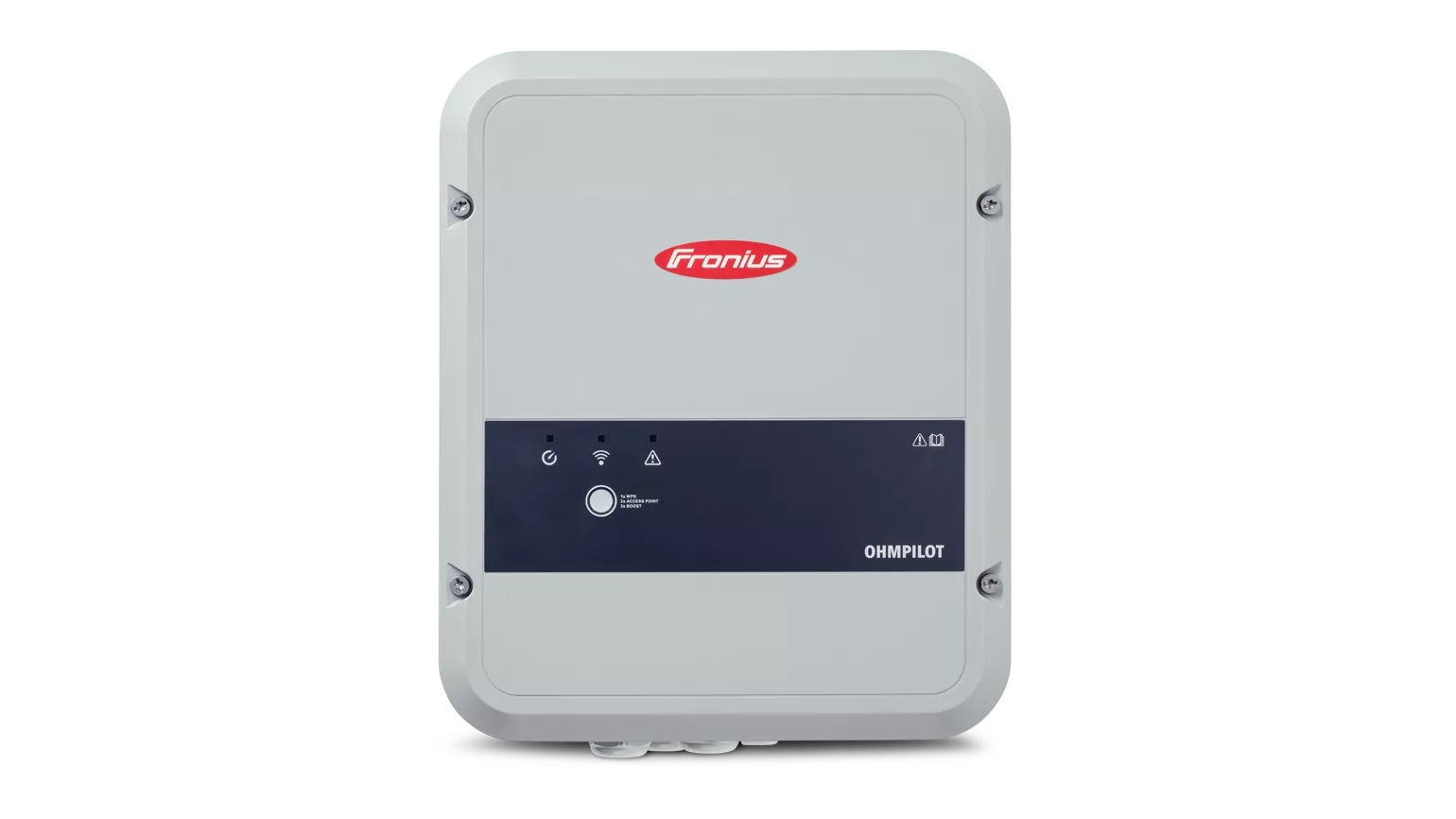
- Fronius Ohmpilot — approximately $1,500–$2,000 supply, around $1,800–$2,500 installed (works natively with Fronius inverters)
- SolarEdge Energy Hub with smart module — built into compatible SolarEdge systems
These devices are most cost-effective if you have an electric storage hot water system and currently export more than 2–3 kWh on a typical day. The payback period on a diverter is typically 2–4 years at current FiT rates — considerably shorter than a battery.
3. Smart EV charging (if you own an EV)
If you have or are planning an electric vehicle, a smart home EV charger can be configured to charge automatically from solar surplus during the day rather than from the grid. OCPP-compatible chargers such as the Zappi (around $1,800–$2,400 supply plus installation) or lower-cost options like the ZJ Beny (around $750) allow solar-following charge modes. An EV can absorb 5–15 kWh of otherwise-exported solar on a typical charging day, making it one of the highest-value self-consumption options if you already own the vehicle.
When does a battery make sense?
Once you have shifted loads and, where applicable, added a hot water diverter, you may still be exporting a meaningful amount. At that point a battery becomes worth modelling — particularly if:
- You are still exporting more than 4–5 kWh/day after load shifting
- Your import tariff is above 28 c/kWh (check your bill — most states are in the 28–34 c/kWh range)
- The gap between your import rate and your export rate exceeds 22 c/kWh
At a 25 c/kWh arbitrage spread, a 10 kWh battery that cycles fully every day would save approximately $912/year in avoided imports. In practice, expect lower. Real-world cycling typically achieves 60–80% of theoretical capacity due to battery state-of-charge management, cloudy days, and household load variation — meaning realistic annual savings are closer to $550–$730 for a 10 kWh system before accounting for any state rebates.
Battery costs have fallen significantly. As at mid-2026, a 10 kWh installed system typically costs $8,000–$10,000 before rebates. The federal government's Cheaper Home Batteries Program (from 1 July 2025) provides approximately $252 per usable kWh in STC-equivalent rebates, reducing a 10 kWh system by roughly $1,800–$2,500. Several states offer additional incentives — notably WA's Residential Battery Rebate of up to $3,800, and NSW's VPP Incentive of up to $1,500 for connecting to a virtual power plant.
With rebates, payback periods of 6–9 years are achievable in states with high import tariffs and strong solar generation.
Demand tariffs: a factor to watch
Some retailers — particularly in SA and Victoria — are beginning to offer or mandate residential demand tariffs that charge based on your highest grid-import peak during a billing period rather than total consumption. Solar and batteries can reduce demand peaks, but the calculation is different from simple arbitrage. If your plan includes a demand charge, factor this into your battery sizing decision.
The trajectory is not improving
Feed-in tariffs are unlikely to increase. Network operators across Australia are investing in managed export controls and export tariff mechanisms that will progressively reduce the value of feeding solar to the grid. Battery costs continue to fall. The combination of low FiTs, high import rates, declining battery prices, and available rebates means the economics of self-consumption are improving each year.
The right sequence for most households: shift loads first, consider a hot water diverter second, then model a battery once those gains are locked in.
Run your own numbers using our free calculator to see where your household sits and whether a battery makes financial sense today.