Your solar panels are working exactly as they should. They're generating clean electricity — often more than your household uses during the day. And yet your power bills haven't dropped as much as you expected.
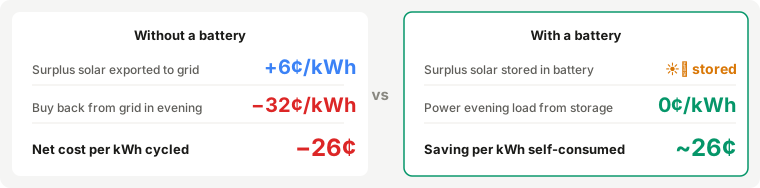
If that sounds familiar, you've run into what's become the central frustration of solar ownership in Australia: the feed-in tariff trap. Your panels export surplus electricity to the grid for somewhere between 4 and 8 cents per kilowatt-hour. Then, when the sun goes down and you need power, you buy it back at 28 to 35 cents per kilowatt-hour — sometimes more.
A home battery changes that equation entirely. Instead of exporting your surplus solar for a fraction of its value, you store it and use it yourself — at night, when you actually need it.
What a battery actually does
Strip away the technical language and a home battery has one job: it stores electricity when you have too much, and releases it when you need more.
In a solar home, "too much electricity" happens during sunny daylight hours when your panels are generating more power than your appliances consume. Without a battery, that surplus flows to the grid. With a battery, it flows into storage instead.
"Not enough electricity" happens from roughly 5 pm onwards, when solar generation drops but household consumption peaks — cooking dinner, running the dishwasher, watching television, charging devices.
The gap between what your panels generate and what your home consumes is exactly the opportunity a battery captures.
Before you invest in a battery: a cheaper first step
Before spending $10,000–$18,000 on a battery, it's worth knowing that a solar hot water diverter — a device that redirects surplus solar into your electric hot water system — costs $400–$900 installed and can shift 3–6 kWh of daily export onto self-consumption.
For households where hot water is a significant load, a diverter often offers a faster payback than a battery and is a sensible first step. If you've already done this (or have a gas hot water system), proceed to battery evaluation.
Your battery's typical day
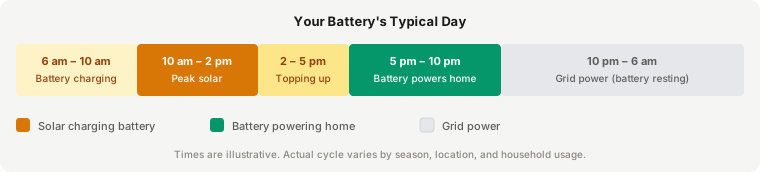
On a typical sunny day in a northern or central Australian state, here's what's happening across your system from dawn to midnight. Note that winter performance — and timing — varies significantly: in southern states like Victoria and Tasmania, generation starts later, peaks are shorter, and daily output in June can be 60–70% of summer levels. The cycle below is broadly representative of a sunny climate; your installer can model your specific location and season.
6–10 am. As the sun rises, your panels begin generating electricity. Appliances running in the morning — the fridge, hot water system, standby devices — run on solar directly. Any generation above your immediate consumption starts charging the battery.
10 am–2 pm. Peak solar generation. Your panels are producing at or near their rated output. If the battery fills up, any remaining surplus flows to the grid at the feed-in tariff.
2–5 pm. Solar generation begins declining as the sun moves lower. Your battery continues topping up if it isn't already full.
5–10 pm. The critical window. Solar generation has dropped below household consumption. Without a battery, you'd draw from the grid at full import rates. With a battery, stored solar powers the home instead — lights, cooking, entertainment, all running on electricity you generated yourself earlier in the day.
10 pm–6 am. Once the battery is depleted — or reaches its minimum reserve of around 10–20% — your home switches to grid power for the rest of the night.
What's inside the box
You don't need to understand the electronics to make a good purchasing decision, but a brief overview helps when comparing products and reading quotes.
Battery cells are where electricity is stored as chemical energy. Two main chemistries are used in residential systems. Lithium iron phosphate (LFP) is the most common across the broader market — it's thermally stable, handles thousands of charge cycles well, and is used by brands including GoodWe, Sungrow, BYD, and Enphase. Nickel manganese cobalt (NMC) offers higher energy density in a smaller package and is used by Tesla Powerwall — the largest-selling premium battery in Australia. NMC systems typically have slightly lower cycle counts and are less thermally stable than LFP, though both are safe in residential installations when installed correctly.
Round-trip efficiency is worth understanding before you calculate savings. Batteries return roughly 90–95% of the energy put into them (LFP tends toward the higher end; NMC slightly lower). In practice, 10 kWh stored delivers around 9–9.5 kWh of usable power. This affects every savings figure in this article — a small but meaningful difference for accurate payback calculations.
The battery management system (BMS) monitors every cell in real time — voltage, temperature, state of charge — and prevents overcharging or over-discharging. It's why you can leave a battery running unattended for years without incident.
The inverter converts electricity between DC (how the battery stores it) and AC (how your appliances use it). In some systems this is a dedicated hybrid inverter; in others each battery module contains its own built-in inverter.
One terminology point: batteries are advertised with a nominal capacity (say, 13.5 kWh) but a lower usable capacity. The BMS maintains a buffer at both ends of the charge range — batteries aren't taken to 0% or charged to 100% because doing so accelerates wear. Always use the usable capacity figure when sizing.
AC-coupled vs DC-coupled: what it means for retrofits
If you're adding a battery to an existing solar system, the coupling type matters — and it affects which batteries are compatible with your setup.
DC-coupled systems connect the battery directly to the solar panels via a hybrid inverter, before the power is converted to AC. This is more efficient (no extra conversion step) and is common in new installations where the solar and battery are installed together. Sungrow, GoodWe, and Tesla Powerwall 3 use this approach.
AC-coupled systems connect the battery to your home's AC circuit via its own inverter, independently of your existing solar inverter. This is the most common approach for retrofits — it works with any existing solar setup regardless of brand or inverter age. Enphase IQ batteries use AC coupling. The trade-off is a small additional efficiency loss at each conversion step.
If you have a working inverter you want to keep, discuss AC-coupled options with your installer. If you're installing solar and battery together for the first time, a DC-coupled hybrid inverter is usually the more efficient choice.
Three things a battery can do for you
1. Reduce your electricity bills
This is the primary financial benefit for most households. Every kilowatt-hour you store and self-consume — rather than exporting cheaply and buying back expensively — is worth roughly the difference between your import and export rates.
With a typical Australian import rate of around 32 c/kWh and a feed-in tariff of around 6 c/kWh, each kilowatt-hour cycled through the battery (accounting for ~93% round-trip efficiency) saves approximately 26 cents net. A 10 kWh battery cycling fully on most days delivers annual savings in the range of $800–$1,000 in a sunny climate — Brisbane, Perth, or Darwin, for instance. In Melbourne or Adelaide, where winter generation is substantially lower, expect the annual figure to be 15–25% lower.
One important caveat: battery capacity degrades over time. LFP systems typically retain 70–80% of original capacity after 10 years of daily cycling. Savings in year 10 will be meaningfully lower than in year 1, and any payback calculation should account for this gradual decline rather than extrapolating year-1 savings across the full warranty period.
2. Greater savings if you're on a time-of-use tariff
If your electricity plan has time-of-use (TOU) pricing — where peak rates apply in the evening window (typically 3–9 pm) — a battery's financial case strengthens considerably. Some TOU peak rates reach 45–55 c/kWh during peak windows, while off-peak rates overnight can be as low as 15–20 c/kWh. A battery that consistently covers your 5–9 pm load is displacing the most expensive power you'd otherwise consume. If you're on a flat-rate tariff, the arbitrage is lower. If you're not sure which tariff you're on, check your electricity bill's rate schedule.
3. Use more of your own solar
Many solar owners feel quiet frustration at exporting large amounts of electricity for minimal return. A battery changes the self-consumption picture substantially — a well-sized system typically shifts self-consumption from 30–40% of solar generation to 70–85%. You're using what you generate, on your own terms, and this benefit compounds as feed-in tariffs continue their long-term decline.
4. Keep the lights on during outages
Many home batteries can operate in backup or island mode when the grid goes down. Your battery and solar panels form a self-contained power source — lights, refrigeration, and essential appliances continue running while the grid is down.
This is increasingly valued in bushfire-prone areas, during storm season, and for households with medical equipment or home offices that can't tolerate unplanned interruptions. Not all batteries support backup mode, and the capability varies: some provide whole-home backup, others protect only a selected circuit. If backup is a priority, confirm the specific capability before purchasing.
What affects how much you'd actually save
Your tariff gap and tariff type. The wider the spread between import and export rates, the more each kilowatt-hour cycled is worth. TOU customers with 45 c/kWh evening peaks benefit far more than flat-rate customers at 28 c/kWh.
How much you currently export — and when. A battery can only store surplus solar. If you're exporting 8–12 kWh per day on annual average, a battery has plenty to work with. If you're averaging less than 3 kWh, the economics are difficult to justify. Note the word average: someone exporting 10 kWh in summer and 1 kWh in winter averages 5.5 kWh, but a battery sized for summer surplus will cycle only partially through winter months. Your installer should model seasonal variation for your location, not just use a single annual average.
Your evening consumption. Households with electric cooking, ducted air conditioning, or EV charging in the evening extract significantly more value from a battery than those with minimal post-5pm load.
Battery size relative to your usage. An undersized battery depletes early in the evening; an oversized battery may never fully charge in winter. The goal is a battery that charges fully on most sunny days and runs to its reserve level by around 10–11 pm most evenings.
Is a battery right for your home?
Batteries make the strongest financial case for households that:
- Export more than 5 kWh of solar per day on an annual average (with seasonal variation modelled for your location)
- Face an import tariff above 28 c/kWh — or are on a TOU tariff with evening peak rates
- Have meaningful evening electricity consumption — 8 kWh or more per day
- Are eligible for a state or federal incentive — the federal Cheaper Home Batteries Program applies a point-of-sale discount of approximately $252/usable kWh through your installer, and WA, NSW, and ACT each offer additional state top-ups. See our rebates guide for current program status
They're harder to justify if your solar system is small relative to your load, your feed-in tariff is still generous, or your evening consumption is low.
It's also worth checking whether your state's incentive program is linked to VPP (virtual power plant) participation — in South Australia in particular, subsidised batteries often require enrolment in a VPP program as a condition. See our VPP programs guide for a full comparison of what's available.
The right answer for your specific situation depends on your actual usage numbers, your tariff structure, your solar system size, your location, and the seasonal pattern of your generation. A sizing calculator that models your household's hourly energy flows is the most reliable way to get a real payback figure.