If you've been researching battery storage for a while, you've likely encountered articles listing rebates from programs that no longer exist. Victoria's battery loan is closed. South Australia's Home Battery Scheme closed in 2022. Queensland's Battery Booster ran out of funding in 2024.
That outdated information makes the rebate landscape look more generous than it is — and leads some homeowners to delay purchasing on the assumption they're waiting for a program that will never reopen.
Here's what's actually available as of May 2026.
The headline: a new federal rebate covers everyone
Since 1 July 2025, a federal program called the Cheaper Home Batteries Program (CHBP) has been running nationally. It works through the existing Small-scale Technology Certificate (STC) mechanism — the same mechanism that has delivered rooftop solar discounts for over a decade.
The way it works in practice: your battery installer claims a set of STCs on your behalf and passes the value to you as a point-of-sale discount. You don't apply for anything, and you won't receive a separate rebate cheque — the saving appears directly in the price your installer quotes you.
How much does it save?
The rebate tapered on 1 May 2026. For systems installed from that date onwards:
- 0–14 kWh usable capacity: approximately $252/usable kWh off the installed price
- 14–28 kWh usable capacity: approximately $151/usable kWh (60% factor) for capacity above 14 kWh
- 28–50 kWh usable capacity: approximately $38/usable kWh (15% factor) for capacity above 28 kWh
For the batteries most Australian homes install:
| Battery (usable kWh) | Federal CHBP discount (from 1 May 2026) |
|---|---|
| 10 kWh | ~$2,520 |
| 13 kWh | ~$3,276 |
| 16 kWh | ~$3,528 + $302 = ~$3,830 |
Important: these figures are calculated at the current STC spot price. STCs trade on an open market and the price fluctuates — your installer's quote will reflect the rate at the time of installation, which may be slightly higher or lower than the figures above.
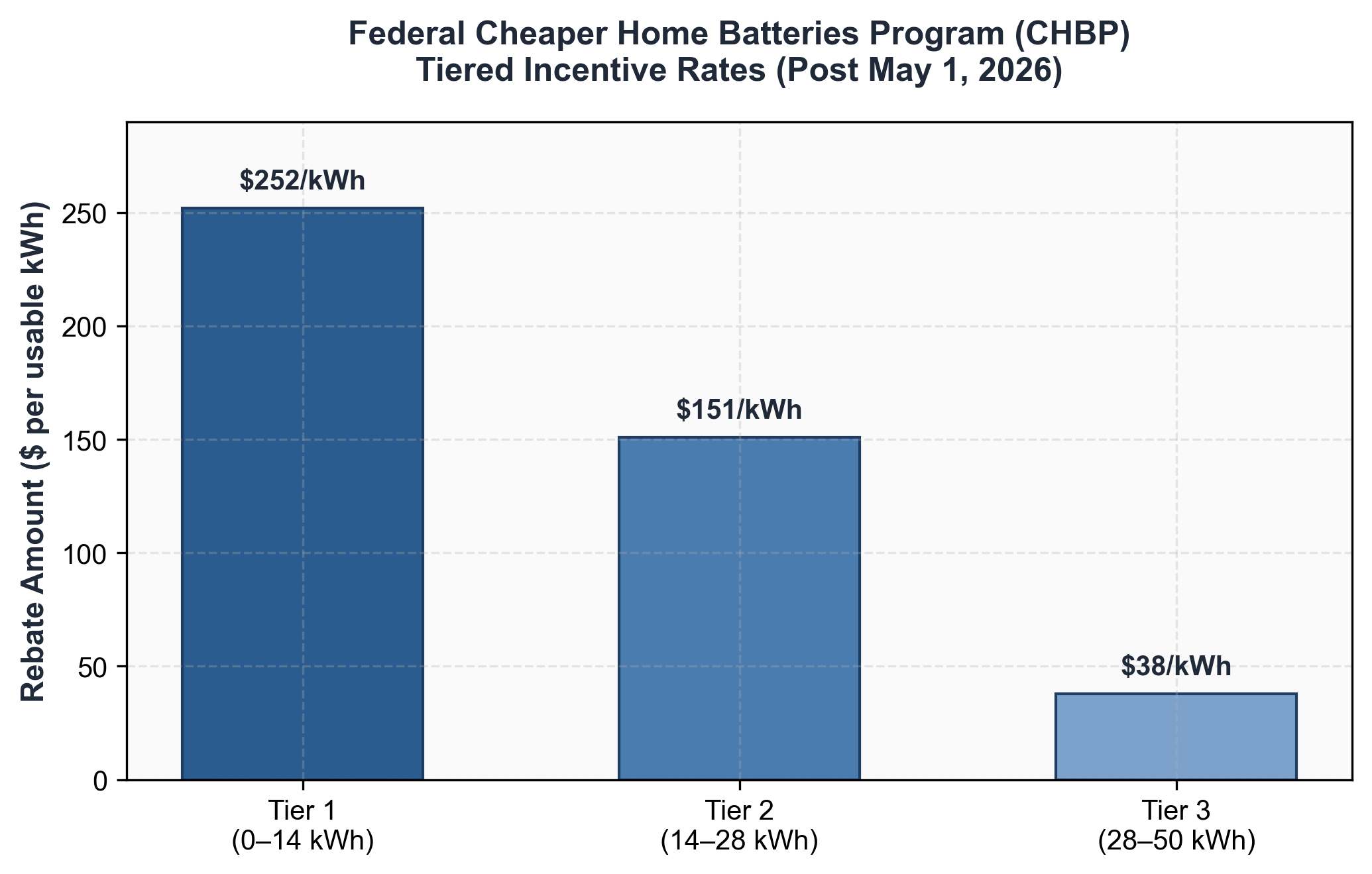
Before 1 May 2026, the same rates were higher (approximately $311/kWh for the first tier). If you're comparing quotes from early 2026 to new quotes, the discount component will be lower — installers aren't pocketing the difference; the STC entitlement itself has reduced.
Who's eligible?
- No income test — all households qualify regardless of income
- Battery must be paired with an eligible solar PV system (new or existing, 100 kW or less) — a standalone battery with no solar does not qualify
- Battery must be 5–100 kWh nominal capacity (rebate calculated on usable capacity, capped at 50 kWh)
- Battery and inverter must appear on the Clean Energy Council's approved product list
- Installer must hold Solar Accreditation Australia (SAA) accreditation
- Applies to systems installed on or after 1 July 2025; earlier installations don't qualify
The program is funded through 2030. Unlike most state programs, it is not capped at a fixed number of places — the STC mechanism is self-executing.
State-by-state: what's open now
Three states have active programs that can be stacked on top of the federal CHBP. Everyone else relies on the federal program alone.
Western Australia — WA Residential Battery Scheme
Status: Open
WA's program launched on 1 July 2025 and is available until 100,000 places are distributed.
State rebate:
- Synergy customers (Perth metro and most of the state): up to $1,300 upfront
- Horizon Power customers (regional and remote WA): up to $3,800 upfront (higher to reflect remote installation costs)
No-interest loan:
- $2,001–$10,000 at 0% interest over 3–10 years
- Income limit: combined household gross annual income under $210,000
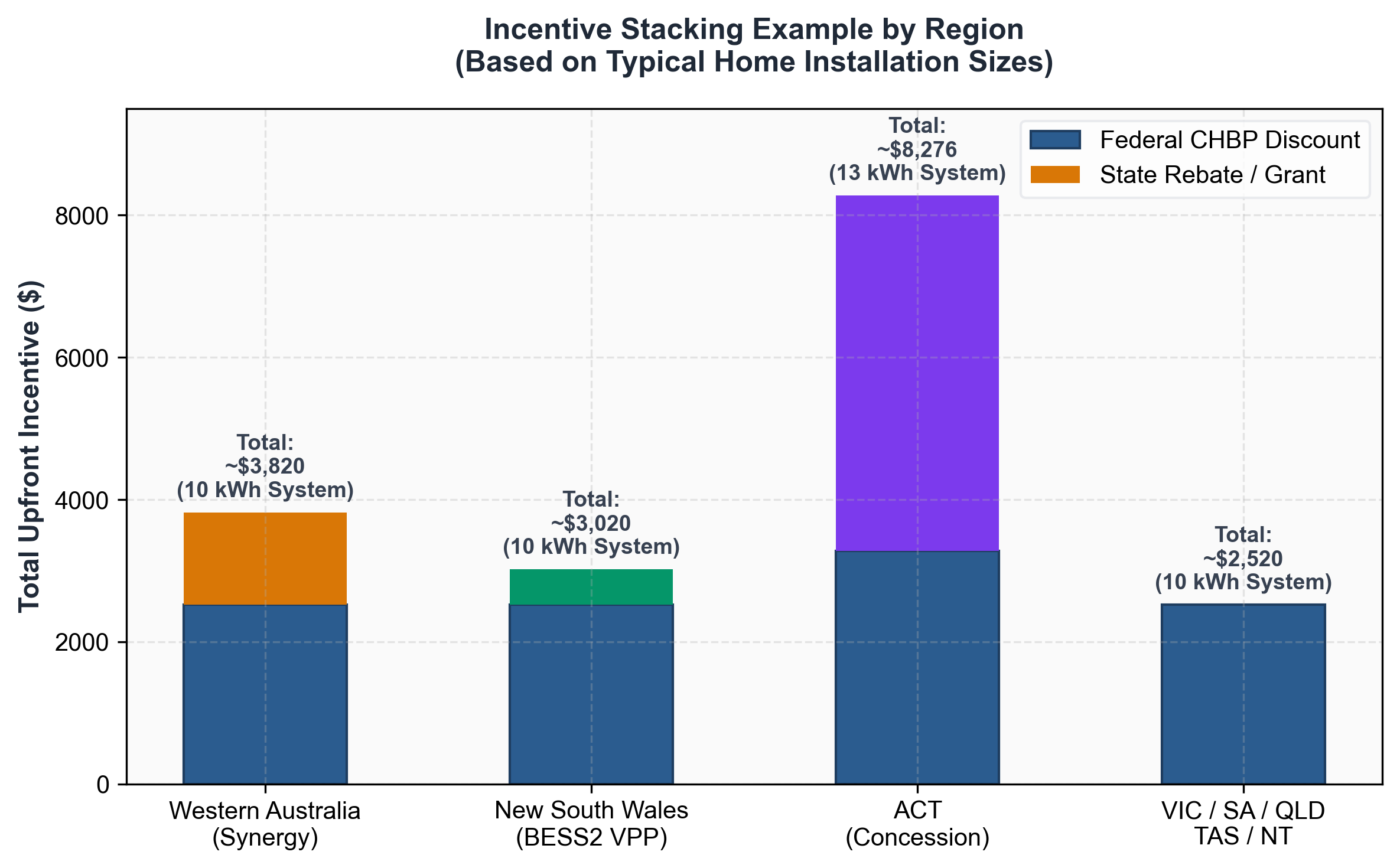
Combined with federal CHBP: A Synergy customer installing a 10 kWh battery could see approximately $3,820 off ($2,520 federal + $1,300 state). A Horizon Power customer in the same scenario could see approximately $6,320 off.
Key condition: VPP participation is mandatory. You must enrol in a VPP product offered by Synergy or Horizon Power as a condition of receiving the state rebate. VPP agreements run for 2 years initially, with opt-out flexibility after that. Being enrolled in a VPP means the network operator can dispatch energy from your battery during peak demand events — your battery may not always be full when you want it. Confirm with your installer how this affects your typical evening usage.
DNSP export limits: Before committing, have your installer check whether your local distribution network has export limits in your area. Some WA network zones restrict or prohibit battery export to the grid. Since VPP dispatch requires export capability, a household in a zero-export zone may not be able to fulfil the VPP condition — which affects rebate eligibility. Your installer can confirm your network's export limit before you apply.
Also eligible: Renters (with landlord consent).
Apply via: Your accredited installer submits the application on your behalf; the loan is administered by Plenti.
More information: wa.gov.au — WA Residential Battery Scheme
New South Wales — VPP Incentive (BESS2)
Status: Open
NSW replaced its earlier upfront battery rebate (which closed June 2025) with a VPP-linked incentive in July 2025.
State incentive: The BESS2 incentive pays approximately $36–$60 per usable kWh for connecting your battery to an accredited VPP provider, up to a maximum of $1,500 (which applies to batteries of roughly 25 kWh and above). For a typical home battery of 10–13 kWh, the NSW incentive is approximately $360–$780.
Combined with federal CHBP: A NSW household installing an 11.5 kWh battery could see approximately $3,300–$3,600 off in total — roughly $2,900 federal plus $400–$700 from the NSW VPP incentive. Larger systems attract proportionally more.
Key condition: Your battery must be VPP-capable and enrolled with an accredited VPP provider to receive the state incentive. A VPP-capable battery without VPP enrolment receives only the federal CHBP discount.
What closed: The Empowering Homes Program (interest-free loans up to $14,000 for solar + battery) closed. The earlier BESS1 upfront rebate closed June 2025. Neither is available for new applications.
More information: energy.nsw.gov.au — Install a Battery
ACT — Sustainable Household Scheme
Status: Open (until 2026, possible extension)
The ACT's Sustainable Household Scheme offers a low-interest loan, not a grant — but the loan terms are favourable enough to meaningfully affect the cost of a battery installation.
Loan details (from 1 July 2025):
- Up to $15,000 at 3% interest over up to 10 years
- No upfront fees
- Administered by Brighte; requires passing their standard lending criteria
- The energy workshop (free, one hour, available online) must be completed before submitting your loan application
Concession holders (Pensioner Concession Card, DVA Gold Card, Health Care Card):
- Up to $5,000 rebate (a grant, not a loan) plus a $10,000 zero-interest loan
- Total support: up to $15,000 combined
Combined with federal CHBP: An ACT household installing a 13 kWh battery could see approximately $3,276 off at point of sale via federal CHBP, then finance the remainder via the ACT loan at 3%.
More information: climatechoices.act.gov.au — Home Batteries
States with no active battery-specific program
Victoria: The Solar Homes battery loan closed late 2024. Victorian households rely solely on the federal CHBP. The Solar Homes panel rebate (up to $1,400) remains available for solar panel installations only.
South Australia: The Home Battery Scheme closed in 2022. SA's emPowering SA initiative provides community-scale batteries in selected locations, but this is not an individual household rebate — it's a government-run program for apartments and low-income households who can't install their own system. Individual SA homeowners rely solely on the federal CHBP.
Queensland: The Battery Booster program (up to $4,000 means-tested rebate) ran out of funding in May 2024. No replacement program has been announced. Queensland households rely solely on the federal CHBP.
Tasmania: The Energy Saver Loan Scheme closed September 2025. Federal CHBP only.
Northern Territory: The NT Home Battery Grant closed June 2025 after reaching its funding cap. Federal CHBP only.
Quick reference table
| State | Active program | Approx. state benefit | Federal CHBP | Stackable? |
|---|---|---|---|---|
| All states | Cheaper Home Batteries Program | ~$252/kWh (capped at 50 kWh usable) | Yes — this is the federal program | N/A |
| WA | WA Residential Battery Scheme | $1,300 (Synergy) / $3,800 (Horizon) | Yes | Yes |
| NSW | VPP Incentive (BESS2) | ~$36–$60/kWh (max $1,500) | Yes | Yes |
| ACT | Sustainable Household Scheme | $15,000 loan at 3%; up to $5,000 grant (concession) | Yes | Yes |
| VIC | None (battery loan closed) | — | Yes | — |
| SA | None (HBS closed 2022) | — | Yes | — |
| QLD | None (Battery Booster closed 2024) | — | Yes | — |
| TAS | None (Energy Saver Loan closed 2025) | — | Yes | — |
| NT | None (grant closed 2025) | — | Yes | — |
VPP programmes: ongoing revenue, not upfront savings
Several states encourage VPP participation through ongoing revenue rather than upfront rebates. These are separate from the rebates above.
- SA — SA VPP (AGL): Households with a compatible battery (Tesla Powerwall or sonnen) join the world's largest VPP network. The benefit is a 25% discount on electricity rates below the Default Market Offer — approximately $575/year in bill savings. No upfront payment from the VPP itself.
- SA — sonnenConnect: $100 sign-up bonus plus up to $24/month for allowing dispatch to the grid.
- NSW: Accredited VPP providers pay grid credits for battery dispatch events; amount varies by provider.
- WA: Synergy and Horizon Power pay a premium rate during peak dispatch events. These events are infrequent — most days your battery won't be dispatched — so actual annual VPP revenue should not be the primary factor in your financial case.
VPP participation is separate from — and additional to — any upfront rebate. In WA and NSW, VPP enrolment is a condition of receiving the state rebate, so the ongoing revenue comes alongside the upfront discount.
If VPP participation is relevant to your situation, see our VPP programs guide for a full state-by-state comparison of what each programme pays and what it requires.
What to watch out for
Outdated information is common. Many comparison sites and blog posts still list programs that have closed. Before making decisions based on a rebate, verify the program's current status directly with the relevant government website. Programs open and close faster than most content on the web updates.
The CHBP discount is already in your quote. You will not receive a separate rebate payment or cheque. The STC discount is claimed by your installer and passed on as a reduction in the price they charge you. If your quote doesn't show the CHBP discount as a line item, ask your installer to itemise it so you can verify it's been applied.
The CHBP requires existing or new solar. If you have an existing solar system, you can add a battery and claim the CHBP — you don't need to buy new panels. If you have no solar at all, you'll need to install solar and battery together to qualify.
DNSP export limits can affect what's possible. Your local distribution network may restrict how much power your home can export to the grid. In some areas this limit is zero. This matters most in WA (where VPP dispatch is mandatory) but is worth checking anywhere — your installer can look up your address's export limit before you sign anything.
Switchboard and wiring upgrades add to the real cost. Many homes need additional electrical work before a battery can be installed: a dedicated battery circuit, upgraded RCD protection, or conduit runs for multi-storey homes. These costs typically run $500–$1,500 and are not covered by any rebate program. Ask for a complete itemised quote that includes all electrical work, not just the battery and inverter.
Usable vs nominal capacity. The CHBP discount is calculated on usable capacity, not the nominal capacity figure on the product specification sheet. Manufacturers publish both; always use the usable figure when working out the federal discount.
Installer accreditation matters. The federal discount flows through your installer's STC claim. If your installer isn't SAA-accredited or uses a battery not on the CEC approved list, you don't receive the discount. Confirm both before signing.
Ask about AS/NZS 5139 compliance. This is the Australian standard governing battery installation — covering location, fire separation, ventilation, and wiring. A non-compliant installation can void your home insurance and creates genuine risk. Any competent installer will confirm compliance without hesitation.
Warranty versus performance guarantee are not the same thing. The headline warranty period (typically 10 years) tells you little about what you're actually protected against. What matters is the performance guarantee: does the manufacturer warrant that the battery will retain at least 70% of its original usable capacity at the end of the warranty period? Some do — some only warrant against defects, not capacity degradation. Ask for the performance guarantee in writing before comparing products on price.
Get at least three quotes. For the same 10 kWh battery from the same manufacturer, installed prices in the same postcode can vary by $1,500–$2,500. After incentives, the cheapest compliant quote is almost always the right choice.
Putting it together: what a typical installation might look like
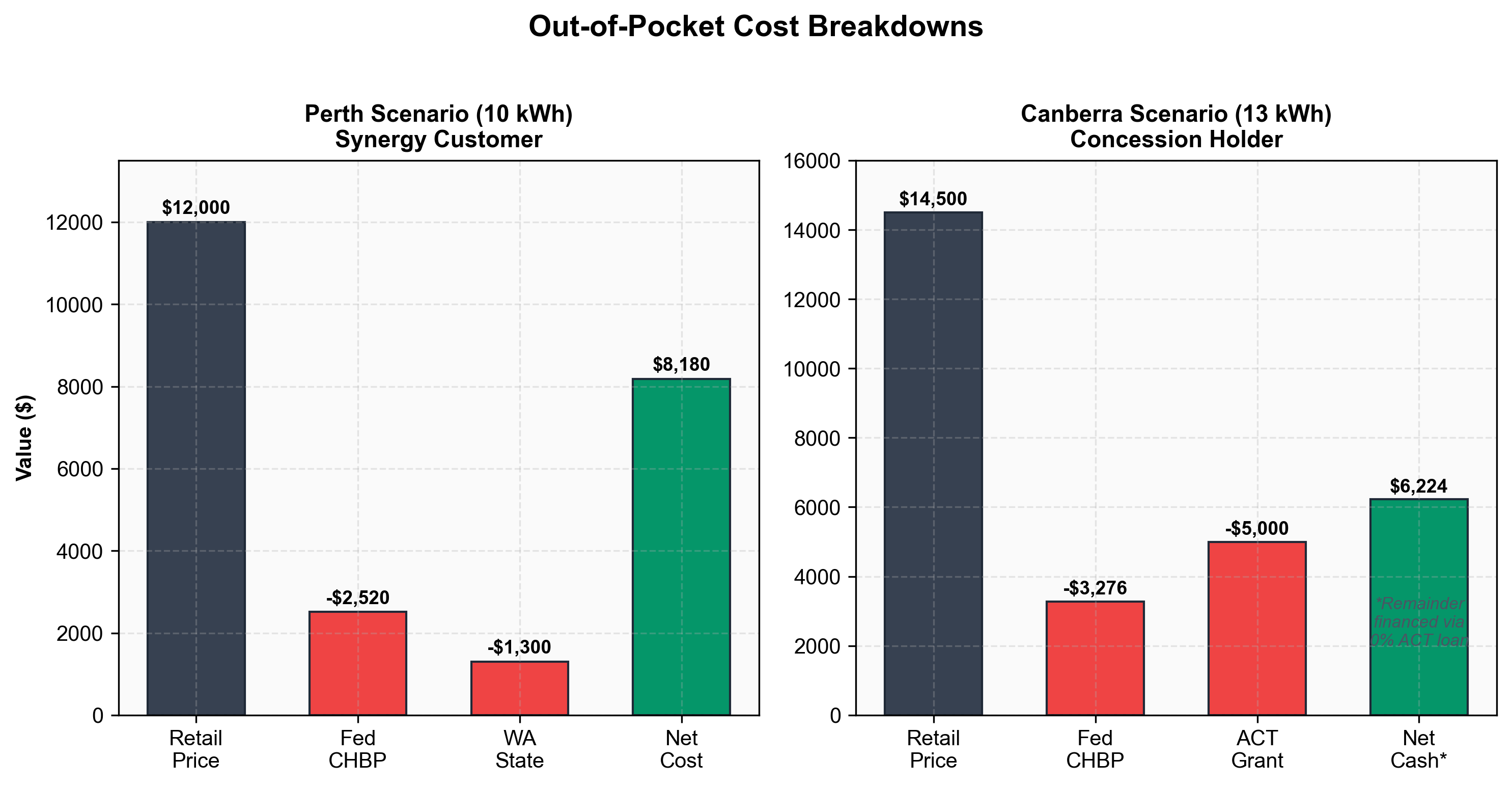
These scenarios use mid-range installed prices based on current market rates. Actual quotes will vary — getting multiple quotes is the single highest-leverage action you can take to reduce out-of-pocket cost.
Scenario: Perth homeowner, Synergy customer, 10 kWh battery
| Cost component | Amount |
|---|---|
| Installed battery system (mid-range quote) | $12,000 |
| Less: Federal CHBP (10 kWh × $252/kWh) | −$2,520 |
| Less: WA state rebate | −$1,300 |
| Net out-of-pocket | $8,180 |
| WA no-interest loan (optional, if income eligible) | 0% over up to 10 years |
Scenario: Canberra homeowner (concession holder), 13 kWh battery
| Cost component | Amount |
|---|---|
| Installed battery system (mid-range quote) | $14,500 |
| Less: Federal CHBP (13 kWh × $252/kWh) | −$3,276 |
| Remaining after federal rebate | $11,224 |
| Less: ACT concession rebate | −$5,000 |
| Less: ACT zero-interest loan (covers balance) | 0% over 10 years |
| Net cash outlay at purchase | $6,224 (balance financed at 0%) |
What this means for your decision
The federal CHBP is a permanent feature of the incentive landscape until at least 2030, and it applies regardless of which state you're in. It typically takes approximately 25–30% off a typical home battery system.
State programs add on top, but only in WA, NSW, and ACT are those state programs currently open. Homeowners in Victoria, South Australia, and Queensland receive the federal discount only.
Whether the resulting after-incentive cost makes financial sense depends on your electricity usage, your tariff, how much solar you export, and the size of system your roof and budget allow. Our calculator takes your actual numbers — usage, tariff, solar size, and location — and models the full 25-year financial return, so you can see the payback period with current incentives applied.