Virtual power plant (VPP) programs are one of the less-understood but increasingly valuable parts of the home battery market. They can meaningfully improve the financial case for a battery — but they require giving up some control of when your battery charges and discharges.
VPP terms, payment rates, and program availability change frequently. Always confirm current details directly with the provider before signing up.
What is a VPP?
A VPP is a network of home batteries that a retailer or network operator can control collectively to balance grid demand. During a grid stress event — such as a hot summer afternoon when air conditioners are running flat out — the VPP operator can draw power from thousands of home batteries simultaneously, reducing peak demand on the grid.
In exchange for allowing this control, you receive financial incentives: either upfront discounts on the battery purchase, ongoing bill credits, or higher export tariffs when your battery is dispatched.
Major VPP programs currently open
Origin Loop
Origin Loop is currently one of the most active VPP programs in Australia. It is open to customers in NSW, VIC, SA, and QLD.
Compatible batteries include Tesla Powerwall, Sungrow, BYD, Alpha ESS, GoodWe, Eveready, Sigenergy, GivEnergy, Solax, and Enphase IQ. Origin updates this list regularly — confirm your model is supported before proceeding.
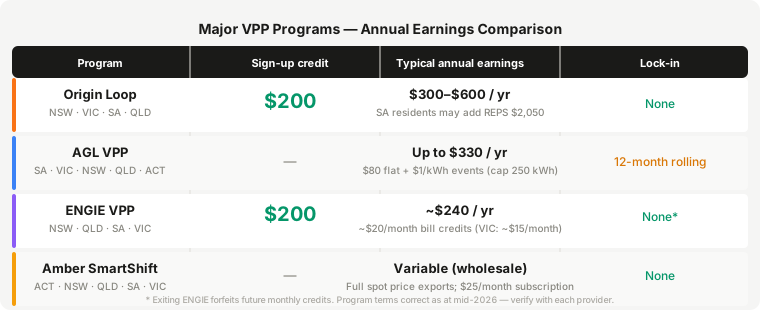
The payment structure offers a $200 sign-up bill credit once connected, plus $1.00 per kWh exported during Loop events, capped at 200 kWh per year. At maximum participation, that equates to roughly $200–$400 in event credits annually, though typical earnings with a 10 kWh battery in an active state like SA are quoted by Origin at $300–$600 per year. SA customers may also be eligible for a cash rebate of up to $2,050 through the SA Government's Retailer Energy Productivity Scheme (REPS) when joining through Origin. NSW customers can claim a separate NSW Government VPP Incentive (BESS2) of $400–$1,500 depending on battery size — this is stackable with Origin Loop and can be claimed upfront.
There is no lock-in contract. You can exit with 20 business days' notice. However, Origin Loop does require you to take your electricity supply from Origin — factor this into the comparison with your current retailer.
AGL VPP
AGL's VPP program is open to both customers with existing batteries (Bring Your Own Battery / BYOB) and customers purchasing batteries through AGL.
Currently compatible batteries include Tesla Powerwall 2 and 3, Sungrow, Alpha ESS, Sigenergy, LG RESU (with SolarEdge inverter), and SolarEdge Energy Bank. AGL states that it is actively expanding the compatible battery list.
The payment structure for BYOB customers is $80 in bill credits per year (paid as $20 per quarter), plus $1.00 per kWh for energy AGL dispatches during VPP events, capped at 250 kWh per year — so a maximum of $330 per year in combined credits. AGL preserves a minimum 20% reserve in Tesla Powerwalls; for other batteries, you can configure the reserve yourself.
The BYOB contract is a 12-month rolling term with 30 days' notice required to exit, and no exit fee. If you take a battery with an AGL upfront discount, you enter a 5-year contract with pro-rata exit fees — read the terms carefully before accepting hardware subsidies.
Available in SA, VIC, NSW, QLD, and ACT.
ENGIE VPP
ENGIE runs a VPP available in NSW, QLD, SA, and VIC. Compatible batteries include Alpha ESS, Empower, Sungrow, Sigenergy, and Tesla.
Payment varies by state. NSW, QLD, and SA customers receive a $200 sign-up credit and approximately $20 in monthly bill credits (roughly $240 per year ongoing). Victorian customers receive a $100 sign-up credit and around $15 per month. There is no fixed contract; you can leave at any time, but doing so forfeits future monthly credits. ENGIE requires you to switch your electricity supply to ENGIE to participate.
Note that ENGIE updated its VPP terms in April 2026 for new sign-ups — confirm the current rates on ENGIE's website.
Amber Electric (SmartShift)
Amber is structurally different from the programs above. Rather than billing you at a flat rate, Amber passes through real-time wholesale electricity prices, and its SmartShift automation charges your battery when wholesale prices are low (and the grid is greener) and dispatches when prices are high.
SmartShift operates at an individual site level rather than calling fleet-wide events, so your battery responds to your own price signals and load profile rather than being dispatched en masse. You receive the full wholesale price for every kWh exported — Amber does not take a cut of event value.
Compatible batteries include Alpha ESS, BYD, Enphase, GivEnergy, LG Chem, Neovolt, Redback, Sigenergy, SolarEdge, Sungrow, and Tesla. Available in ACT, NSW, QLD, SA, and VIC.
Amber SmartShift is an approved VPP under NSW's BESS2 incentive and SA's REPS scheme, so government rebates can still be accessed. NSW customers can earn up to $970 through the BESS2 scheme when connecting through Amber.
The trade-off: Amber involves more engagement. Wholesale prices can be volatile, and the financial benefit depends on how well the automation handles your local market. It suits technically confident customers who are comfortable reviewing their energy account regularly.
South Australia's Housing Trust VPP (AGL/Energy Locals)
This program is specifically for South Australian Housing Trust tenants, not for privately-owned homes. Tesla originally built and operated the SA VPP; ownership transferred to AGL in 2025. Energy Locals is the electricity retailer for participants.
Eligible SA Housing Trust tenants receive solar and a Tesla Powerwall at no cost, with VPP participation as a condition. A typical eligible household can save up to $575 per year on electricity in 2025–26, with electricity rates set 25% below the Default Market Offer. Over 5,500 Housing SA tenants are already participating.
Private homeowners in South Australia looking for VPP programs should consider Origin Loop, AGL VPP, Amber, or ENGIE instead.
Closed or substantially changed programs
Tesla Energy Plan — Tesla's direct-to-customer VPP plan in Australia ended on 30 September 2025. Customers who did not actively switch were moved to Energy Locals' Standing Offer. Tesla has indicated it is developing new energy offers for Australia, but no replacement program had launched at the time of writing. Existing Powerwall owners can still participate in other VPP programs (Origin Loop, AGL VPP, Amber) if their model is on the compatible battery list.
What to consider before joining a VPP
How much control do you give up?
Understand what happens during a VPP event. The operator will remotely dispatch your battery — typically drawing it down during the late afternoon or early peak period. If your battery is already depleted from a VPP event when the evening peak arrives, you may be buying grid power at high rates. Ask each provider:
- How many events typically occur per year?
- What is the maximum depth of discharge per event?
- What minimum reserve will the operator maintain?
- Can you opt out of individual events, and how?
What is the actual financial benefit?
Upfront credits are easy to value. Ongoing per-kWh event credits depend entirely on how often events are called — providers rarely publish average event frequency by state. In high-renewable states like SA and QLD, events can be frequent; in other states, they may be rare. Ask the provider for a realistic annual earnings estimate in your postcode, and treat it as an estimate rather than a guarantee.
Retailer lock-in
Most VPP programs require you to purchase electricity from the program operator. Before enrolling, compare the provider's electricity rates — standing offer rates, peak/off-peak structure, and solar feed-in tariff — against your current retailer. A generous VPP credit can be more than offset by a higher electricity rate. Use an energy comparison tool or request a bill estimate using your historical consumption before switching.
Battery compatibility and API access
VPP operators require software integration with your battery's inverter API. Not all firmware versions or inverter pairings are supported — even within a compatible brand. Confirm your exact model and firmware version with the provider, not just the brand name.
Battery sizing and VPP participation
If you plan to join a VPP, it can affect optimal battery sizing. A larger battery provides a buffer: if the operator dispatches 5–10 kWh during a peak event, a 15+ kWh system still has meaningful capacity for your own evening use. A 10 kWh battery can be left uncomfortably depleted after a large event.
Our battery calculator includes a VPP participation toggle that adjusts the sizing recommendation to account for this.
Government incentives for VPP connection
Several state and federal schemes offer upfront payments for connecting a battery to a VPP:
- NSW: Up to $1,500 upfront via the BESS2 VPP Incentive (from 1 July 2025), stackable with the Commonwealth Cheaper Home Batteries rebate
- SA: Up to $2,050 via the Retailer Energy Productivity Scheme (REPS) through eligible retailers
- Federal: The Cheaper Home Batteries Program reduces the cost of eligible battery systems nationally
Eligibility criteria and funding availability change. Check current state government energy websites for up-to-date conditions.